
Mental Health Resources
This page is for parents, teens, and families who need professional mental health support, whether that's a crisis line, a trauma therapist, affordable counseling, or local support services.
Resources are organized from most urgent to most specific.
CRISIS SUPPORT
If there is immediate danger, call 9-1-1
If you or your teen are in crisis right now:
988 Suicide & Crisis Lifeline: Call or text 988 — 24/7, free, confidential. For suicidal thoughts, self-harm, or any mental health emergency. Available in English and Spanish with interpreter services in 240+ languages. Teens can call or text.
Crisis Text Line: Text HOME to 741741 — 24/7, free, confidential. Text with a trained crisis counselor. Many teens find texting easier than calling.National Domestic Violence Hotline
Call 1-800-799-7233 and TTY 1-800-787-3224National Domestic Violence Hotline: 1-800-799-7233 | Text START to 88788 — 24/7 crisis support for domestic violence and relationship abuse. TTY: 1-800-787-3224.
SEXUAL ASSAULT SUPPORT
If you or your teen has been sexually assaulted, RAINN is the most important first call. They connect you with a local rape crisis center that provides FREE therapy for survivors AND a victim advocate who can walk alongside you through the legal process.
RAINN National Sexual Assault Hotline: 1-800-656-HOPE (4673) — 24/7, free, confidential. Call or chat online. Connects you with your local rape crisis center.
rainn.org/get-help also has a local search tool to find in-person services near you.
Victim Advocate (through your local DA's office): Ask your RAINN advocate or local law enforcement — If charges are being filed, a victim advocate is assigned to your case for free. They help you understand the process, prepare for court, and connect you with services. This is a right, not a privilege.
FINDING A THERAPIST
Free and Low-Cost Options
If cost is a barrier, these options can help you find real therapy without paying full private-practice rates:
Community Health Centers (FQHCs): findahealthcenter.hrsa.gov — Government-funded health centers that see patients regardless of ability to pay. Use a sliding fee scale based on income — many families pay $0. Offer licensed therapists and sometimes psychiatrists. Nearly all accept Medicaid.
2-1-1 / First Call for Help: Dial 2-1-1 or visit 211.org — Free helpline that connects you with local mental health services, many of which are free or low-cost. Operators know what's available specifically in your area.
SAMHSA Treatment Locator: findtreatment.gov — Search for mental health and substance use treatment near you, with filters for low-cost and free programs. Run by the federal government.
Open Path Collective: openpathcollective.org — Network of 40,000+ vetted therapists offering sessions at $40-$80 for those who can't afford full rates. One-time membership fee of $65-$89. Not for those with insurance or who can pay full rates.
University Training Clinics: Search "[your city] university counseling clinic" — Universities with psychology or counseling programs offer free or very low-cost therapy with supervised graduate students. Quality is often excellent.
Finding a Private Therapist
Psychology Today Therapist Finder: psychologytoday.com/us/therapists — Search by location, specialty, insurance, and sliding scale. The most comprehensive therapist directory in the US.
TEEN-SPECIFIC RESOURCES
Teens often respond better to resources designed for them, especially text-based options where they don't have to talk out loud.
988 (call or text): 988 — The main crisis line works for teens too. Available 24/7.
Crisis Text Line: Text HOME to 741741 — 24/7. Many teens prefer this to calling.
Teen Line: Call (800) 852-8336 | Text TEEN to 839863 — Confidential support line staffed by trained teen volunteers. Available nightly 6-10pm PST (phone) and 6-9pm PST (text). For teens who want to talk to another teen.
NAMI Teen & Young Adult HelpLine: Call 1-800-950-NAMI | Text FRIEND to 62640 — Specialized support for teens and young adults from trained NAMI volunteers. Available during extended hours.
The Trevor Project (LGBTQ+ Youth): Call (866) 488-7386 | Text START to 678678 — 24/7 crisis and suicide prevention for LGBTQ+ young people under 25. Also chat at TheTrevorProject.org/Help. Free and confidential.
SUPPORT FOR PARENTS & FAMILIES
NAMI Helpline: 1-800-950-NAMI (6264) — Free, confidential support for families navigating a loved one's mental illness. Volunteers are trained family members who have been through it themselves. Also find local NAMI chapters at nami.org.
NAMI Family-to-Family: nami.org/Support-Education/Mental-Health-Education/NAMI-Family-to-Family — Free 8-session education program for family members, caregivers, and loved ones of people living with mental illness.
Al-Anon: al-anon.org — Free support for families and friends of people with an alcohol problem. In-person and online meetings available everywhere.
Nar-Anon: nar-anon.org — Free support for families affected by a loved one's drug use. Similar to Al-Anon.
EATING DISORDERS
National Alliance for Eating Disorders: 1-866-662-1235 | allianceforeatingdisorders.com — Helpline, therapist directory, and support groups for individuals and families dealing with eating disorders. Free and available during business hours.
SUBSTANCE USE
SAMHSA National Helpline: 1-800-662-4357 — Free, confidential, 24/7 treatment referral and information service for individuals and families facing substance use disorders. Also visit findtreatment.gov.
Al-Anon / Nar-Anon: al-anon.org | nar-anon.org — Free support groups for families and friends of people struggling with alcohol or drug use.
HOW TO FIND LOCAL RESOURCES
National hotlines are a great starting point, but local resources — community mental health centers, rape crisis centers, free clinics — are often the most affordable and accessible for ongoing support. Here's how to find what exists in your area:
Call 2-1-1 — This is the fastest way. Operators know exactly what's free and available in your zip code
Visit findahealthcenter.hrsa.gov to find a federally funded health center with sliding-scale mental health services near you.
Call RAINN (1-800-656-HOPE) or visit rainn.org/get-help to find your local rape crisis center, which provides free therapy and advocacy for sexual assault survivors.
Visit nami.org/Support-Education/NAMI-Local to find your local NAMI chapter for mental illness support and family programming.
Search "community mental health center [your city/county]" — Most counties have a publicly funded mental health center that offers free or sliding-scale therapy to residents.
If you have a teen in school: your school counselor often knows the best local referrals and can sometimes facilitate referrals or get reduced-cost services for students.
RECOGNIZING WHEN SOMEONE IS STRUGGLING
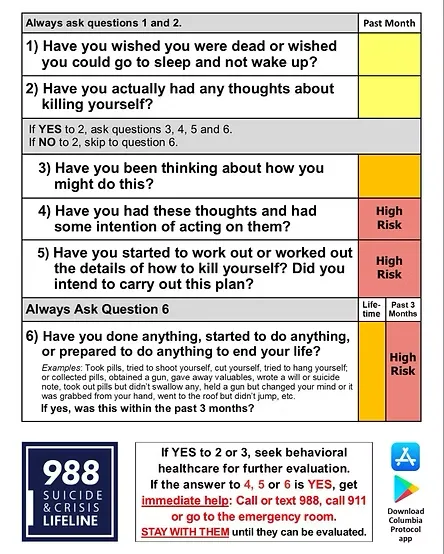
One of the most important things we can do is recognize warning signs early and ask questions without fear. See how this is demonstrated in The Columbia Protocol for assessiong the risk of suicide below.
Suicide Prevention
Suicide Prevention
One of the most important things we can do to prevent suicide is ask questions when we are worried about someone.
Too often people are afraid to embarrass or further upset someone, or they do not know what questions to ask, so they miss opportunities to help people who are really struggling.
The Columbia Protocol, also known as the Columbia-Suicide Severity Rating Scale (C-SSRS), supports suicide risk assessment through a series of simple, plain-language questions that anyone can ask. The answers help users identify whether someone is at risk for suicide, assess the severity and immediacy of that risk, and gauge the level of support that the person needs.
Warning Signs of Mental & Behavioral Health Struggles in Teens
Watch for patterns that represent a change from your teen's baseline:
Social withdrawal or isolation
Sudden drop in grades or school performance
Refusing to go to school
Significant changes in sleep (too much or too little)
Changes in eating habits
Loss of interest in activities they used to enjoy
Increased irritability, anger, or emotional outbursts
Talking about hopelessness, worthlessness, or death
Giving away possessions
Signs of self-harm (unexplained cuts, burns, or bruises)
Increased secrecy, especially around phone or online activity
New friend group with sudden personality shift
Substance use
Panic attacks or severe anxiety
Compulsive or ritualistic behaviors
Note: One sign doesn't mean crisis. What matters is a change in pattern and the intensity and duration of that change. When in doubt, ask directly and calmly.
ADDITIONAL RESOURCES
If you're not sure where to start: call 2-1-1. It's free, available in most of the US, and staffed by people whose job is to know what help exists in your community.
© 2026 MacDermott Method


